

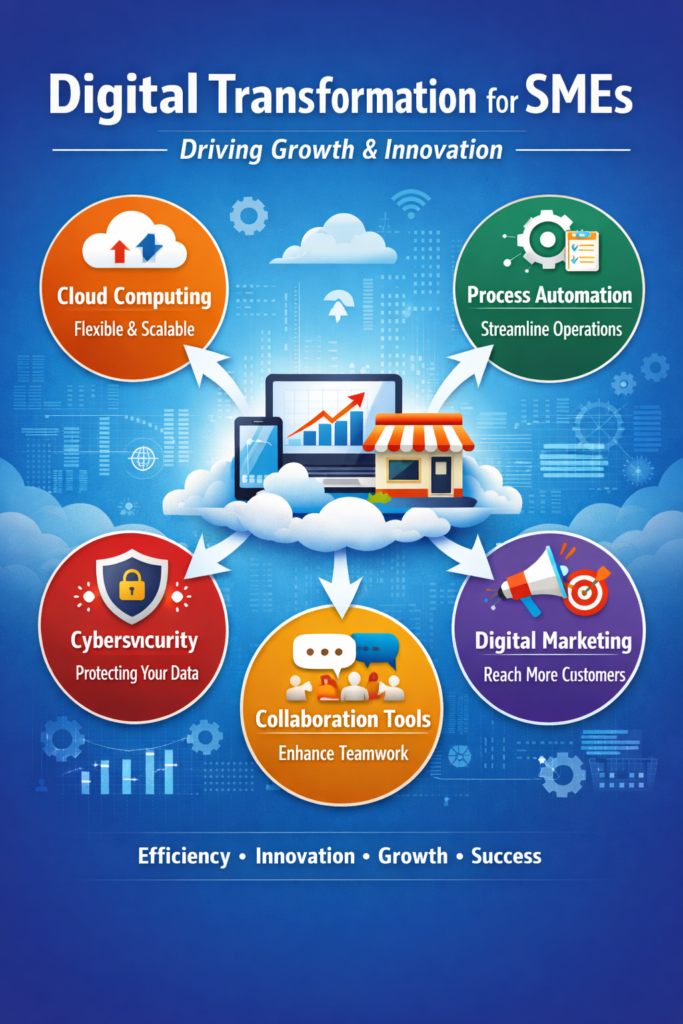
Small and Medium Enterprises (SMEs) are the core of the global economy and play a vital role in innovating, generating jobs, and developing local communities. However, numerous small and medium enterprises fail to keep pace with technological advancement. Digital transformation has become imperative rather than an option, and SMEs should use advanced information technologies to their advantage.
What is Digital Transformation?
Digital transformation entails the use of digital technology in all facets of an organization. It brings about a transformation in how firms operate and provide value to their customers amid changing market conditions. Digital transformation for small and medium enterprises involves shifting away from conventional approaches and embracing technologies such as cloud computing and digital marketing.
Why Digital Transformation Matters for SMEs
Operational Efficiency
Automation helps to decrease errors made by people and saves time that can be spent on something else. Innovation is what SMEs should work on.
Customer Experience Improvement
There are many technologies, such as CRM, bots, and customized marketing campaigns, that help to offer more personalized services.
Making Data-Driven Decisions
Analytics software provides information about customers’ behavior, market trends, and other data to make decisions.
Scalability and Flexibility
Cloud services are great for scaling without spending large amounts of money on infrastructure.
Competitive Advantage
Adopting new technologies helps SMEs to compete with other big companies.
Key Areas of Digital Transformation
1. Cloud Integration
Moving to cloud solutions like Microsoft Azure and AWS would help SMEs to cut costs, gain access to resources, and ensure continuity. Cloud technology can also help to implement remote work and teamwork.
2. Process Automation
Solutions for automation of processes such as invoicing, payroll, and customer care save both time and money for SMEs and also allow being consistent.
3. Cybersecurity
In light of growing cyber threats, it is necessary to implement cybersecurity measures such as multi-factor authentication, encryption, and audits.
4. Digital Marketing
Using SEO, social media, and specific campaigns allows SMEs to increase their reach significantly. Digital marketing offers better ROI than traditional marketing strategies.
5. Collaboration Platforms
Using Microsoft Teams, Slack, and Zoom will enable effective collaboration and communication among team members regardless of where they work from.
Challenges SMEs Face in Digital Transformation
Analyze Present Operations – Areas that can be optimized with digital technology.
Define Objectives – Know what success means, whether in terms of efficiency, customer interaction, or saving costs.
Begin with Simple Solutions – Start with less expensive initiatives such as cloud computing or digital invoicing.
Educate Staff – Train employees on the use of new systems.
Work With Experts – Work with IT solution providers in implementing the transition process.
How Crown Hill IT Solutions Supports SMEs
Crown Hill IT Solutions appreciates the specific issues that arise for SMEs. With our specialized IT solutions, we assist businesses in undergoing the process of digital transformation seamlessly. Whether it is through cloud migration, cybersecurity, automation, or digital marketing, our company has you covered with a comprehensive solution package.
Our model of operation is consultative since we work hand in hand with our clients to design the most suitable solutions for them.
Conclusion
However, digital transformation does not imply the adoption of all the latest technologies; it means selecting the most appropriate ones that fit into business needs. For SMEs, such a path might be rather challenging, but the benefits from it will be enormous in terms of efficiency, customer relations, and sustainability.
Today’s leaders will be tomorrow’s champions. That is why we at Crown Hill Solutions are ready to help SMEs embark on the path of digital transformation and succeed.